

Introduction
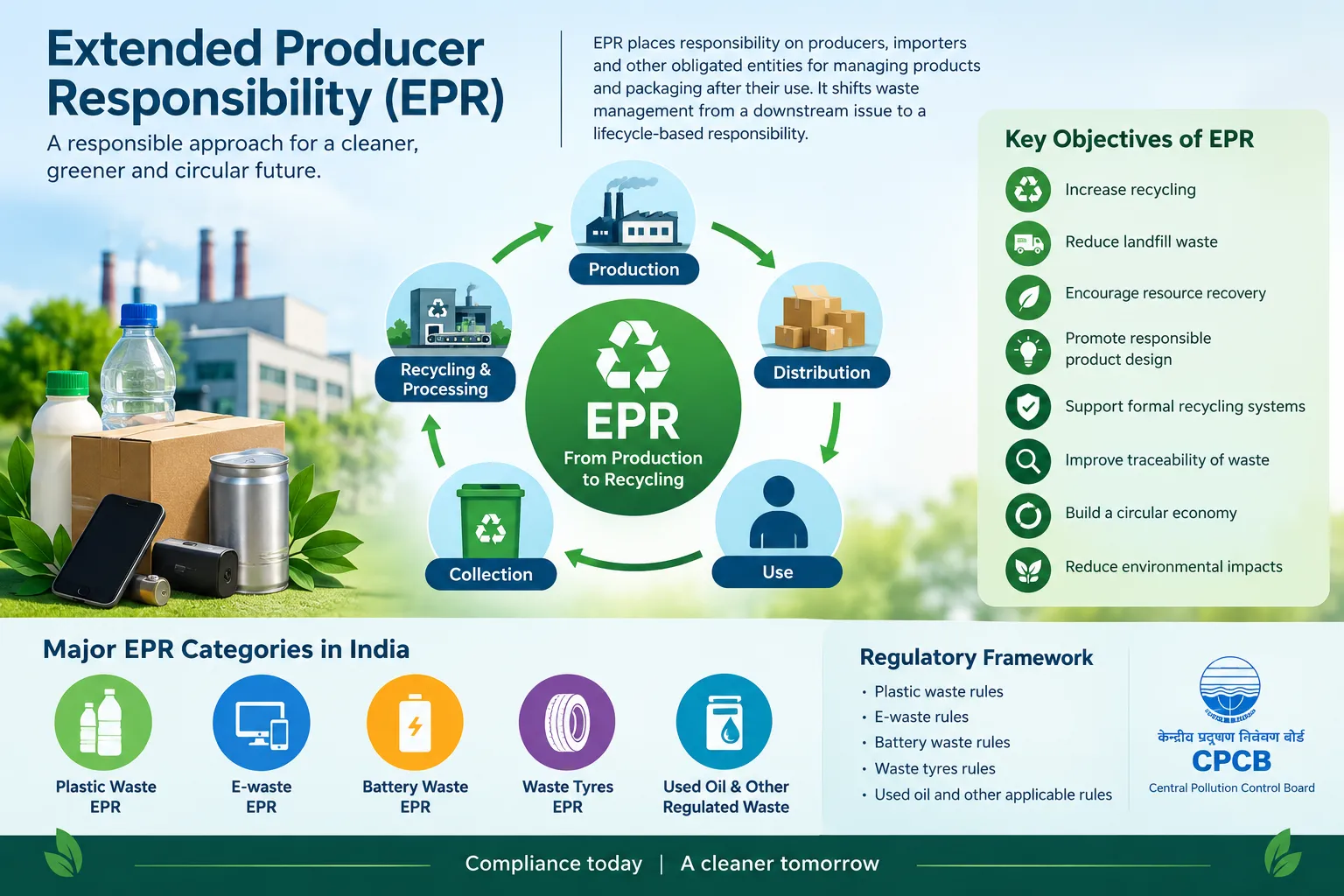
Extended Producer Responsibility (EPR) is an important environmental management approach that places responsibility on producers, importers and other obligated entities for managing products and packaging after their use. The concept aims to shift waste management from being only a downstream responsibility to a broader lifecycle-based responsibility.
In India, EPR has become increasingly important for sectors dealing with plastic packaging, electronic products, batteries and other regulated waste streams. Depending on the applicable rules, obligated entities may need to register on designated government portals, meet recycling or processing obligations, maintain records and submit periodic returns.
For businesses, understanding EPR is important not only for regulatory compliance but also for improving resource efficiency, supporting recycling systems and contributing to a circular economy.
What Is Extended Producer Responsibility (EPR)?
Extended Producer Responsibility is a policy principle under which the producer or other designated entity has responsibility for managing the environmental impacts associated with a product beyond the point of sale or initial use.
Instead of considering waste management solely as the responsibility of municipalities or waste handlers, EPR creates obligations for businesses associated with placing specified products or packaging in the market.
The specific responsibilities depend on the applicable waste-management regulations and the category of product involved.
EPR may involve activities such as:
- Registration with the applicable authority
- Collection or channelisation of waste
- Recycling or processing
- Use of authorised recyclers or processors
- Meeting prescribed targets
- Maintaining transaction records
- Submission of returns
- Maintaining supporting documentation
- Compliance with applicable environmental rules
Why Was EPR Introduced?
The increasing generation of waste has created challenges for collection, recycling, treatment and environmentally sound disposal.
Traditional waste-management systems may not adequately address the entire lifecycle of products. EPR attempts to improve this system by connecting the entities placing products on the market with their post-consumer environmental responsibilities.
The major objectives of EPR include:
- Increasing recycling
- Reducing waste going to landfills
- Encouraging resource recovery
- Promoting responsible product design
- Supporting formal recycling systems
- Improving traceability of waste
- Encouraging a circular economy
- Reducing environmental impacts associated with waste
EPR in India: Regulatory Framework
India's EPR framework is implemented through different environmental rules and regulations depending on the type of waste or product.
Important regulatory frameworks include those relating to:
- Plastic waste
- E-waste
- Battery waste
- Waste tyres
- Used oil and other regulated waste streams, where applicable
For a detailed understanding of one of the major EPR categories, see the Plastic Waste EPR Registration Process in India.
The regulatory requirements can differ significantly between these categories. Therefore, a business should first identify the exact product or waste category applicable to its activities before determining its EPR obligations.
The Central Pollution Control Board (CPCB) plays an important role in implementing and administering several EPR systems through dedicated online platforms and regulatory mechanisms.
Who May Have EPR Obligations?
EPR obligations are not identical for every business.
Depending on the applicable rules, obligations may apply to entities such as:
- Producers
- Importers
- Brand owners
- Manufacturers
- Recyclers
- Waste processors
- Other entities specifically covered by the relevant regulations
For example, an organisation importing packaged products may have different responsibilities from a manufacturer producing packaging material within India.
Therefore, EPR applicability should be determined based on the actual business activity, product category and relevant regulatory framework.
Major EPR Categories in India
Plastic Waste EPR
Plastic Waste EPR applies to specified producers, importers and brand owners covered under the applicable plastic-waste framework.
Businesses may have obligations related to plastic packaging placed on the market, including registration, target fulfilment, recycling and record maintenance as applicable.
Plastic packaging is generally considered in different categories under the regulatory framework, and the applicable obligation depends on the type and quantity of packaging involved.
For businesses specifically dealing with plastic packaging, the Plastic Waste EPR Registration Process provides further guidance.
E-Waste EPR
Electronic and electrical products can generate significant quantities of end-of-life waste
The EPR framework for e-waste places responsibilities on covered entities for ensuring that electronic waste reaches appropriate recycling or processing channels.
Businesses dealing with electrical and electronic equipment should evaluate whether their products fall within the applicable EPR framework and understand their registration, target and reporting requirements.
For more information, see the E-Waste EPR Registration Process in India.
Battery Waste EPR
Battery waste is another regulated waste stream where EPR plays an important role.
Entities covered under the applicable battery-waste framework may have responsibilities relating to collection, recycling or processing obligations and maintaining records through the prescribed system.
Waste Tyre EPR
The waste-tyre framework provides an EPR mechanism for covered producers, importers and other relevant entities.
The objective is to promote environmentally sound processing and recycling of waste tyres and improve traceability within the waste-management system.
How Does the EPR System Work?
Although the detailed procedure varies according to the waste category, the basic concept can be understood through the following flow:
Product Manufacturing/Import → Product Placed on Market → Product Use → Waste Generation → Collection/Channelisation → Recycling/Processing → EPR Compliance & Reporting
The producer or other obligated entity must fulfil the responsibilities prescribed under the relevant regulations.
The process therefore connects product placement with post-consumer waste management.
EPR Registration
Where registration is prescribed, the eligible entity generally needs to submit relevant business and product information through the designated regulatory portal.
Depending on the category, information may include:
- Business details
- Registration details
- Product information
- Production or import quantities
- Packaging information
- Waste-generation information
- Facility details
- Authorised recycler or processor information
- Previous compliance records, where applicable
The exact information requirements depend on the applicable EPR framework.
Businesses should ensure that information submitted during registration is consistent with invoices, production records, import documents and other supporting records.
EPR Targets and Compliance Obligations
One of the important aspects of EPR is the requirement to fulfil prescribed obligations or targets.
Depending on the applicable regulations, these may relate to:
- Recycling
- Collection
- Processing
- Recovery
- Reuse
- Environmental compensation or other prescribed mechanisms
The target calculation can depend on factors such as product quantity, packaging category, historical data and the relevant regulatory provisions.
Therefore, businesses should not assume that one EPR calculation method applies to every waste stream.
Role of Recyclers and Waste Processors
EPR depends heavily on a reliable recycling and processing network.
Covered entities may need to work with recyclers or processors that meet the applicable regulatory requirements.
Proper documentation is important because EPR compliance should be supported by traceable records rather than informal claims of recycling.
Useful records may include:
- Agreements
- Invoices
- Waste movement documents
- Processing certificates
- Quantity records
- Transaction details
- Portal records
- Annual or periodic returns
The exact documentation requirements depend on the applicable EPR regulations.
EPR Certificates and Digital Traceability
Several EPR systems use digital mechanisms to improve the traceability of recycling and processing activities.
Digital records can help connect:
Obligated Entity → Waste Quantity → Recycler/Processor → Processing Activity → Compliance Obligation
This approach can improve transparency and reduce the possibility of unsupported recycling claims.
Businesses should maintain consistency between their internal records and information reported through the applicable EPR portal.
Documents Commonly Required for EPR Compliance
The documentation depends on the category and nature of the business, but may include:
- Company registration documents
- PAN and GST details
- Authorisation or registration documents
- Product details
- Packaging information
- Production data
- Import data
- Sales or dispatch records
- Recycler/processor details
- Agreements with authorised entities
- Recycling or processing certificates
- Previous EPR records
- Annual return information
A proper document checklist should be prepared according to the specific EPR category rather than using a generic list.
Businesses with broader environmental obligations can also refer to the Environmental Compliance Checklist for Industries in India to organize their overall compliance documentation.
Common EPR Compliance Challenges
Businesses often face difficulties not because registration itself is complicated, but because the underlying data and compliance systems are not properly organised.
Common challenges include:
Incorrect Product Classification
A business may incorrectly determine whether its products fall under a particular EPR category.
Inconsistent Quantity Data
Production, sales, import and EPR records may show different quantities.
Incomplete Packaging Information
Packaging materials may not be properly identified or categorised.
Poor Recycler Documentation
Transactions with recyclers may not have sufficient supporting documentation.
Missed Return Deadlines
Failure to submit required information within the prescribed timeline can create compliance issues.
Outdated Registration Information
Changes in company details, products, facilities or business activities may require updating the relevant registration information.
Weak Internal Recordkeeping
If EPR data is maintained manually without proper reconciliation, errors can occur during reporting.
EPR Compliance Checklist for Businesses
Businesses can use the following basic checklist:
- Identify applicable EPR regulations
- Determine whether the business is an obligated entity
- Identify relevant product and waste categories
- Calculate applicable quantities
- Complete required registration
- Maintain accurate product and packaging records
- Work with appropriate recycling or processing channels
- Track EPR obligations
- Maintain supporting documents
- Reconcile internal data with portal submissions
- Submit required returns
- Monitor regulatory updates
- Maintain evidence of compliance
Environmental Benefits of EPR
EPR can contribute to better waste management and resource conservation by encouraging recovery and recycling.
Potential environmental benefits include:
- Reduction in landfill disposal
- Increased recycling
- Recovery of valuable materials
- Reduced pressure on natural resources
- Improved waste traceability
- Support for circular-economy systems
- Better management of post-consumer waste
The effectiveness of EPR ultimately depends on proper implementation, monitoring and verification.
EPR and the Circular Economy
EPR is closely connected with the concept of a circular economy.
In a conventional linear model, resources generally follow:
Raw Material → Manufacturing → Consumption → Waste
A circular approach attempts to keep materials within the economic system for longer:
Raw Material → Manufacturing → Consumption → Collection → Recycling → Recovered Material → New Products
EPR can support this transition by creating stronger links between producers, consumers, waste collectors, recyclers and regulators.
How SimpliComp Can Help with EPR Compliance
Businesses dealing with regulated products and waste streams may need support in understanding their EPR applicability and maintaining ongoing compliance.
SimpliComp can support businesses with environmental compliance requirements related to applicable EPR frameworks, including:
- EPR applicability assessment
- Documentation support
- Registration assistance
- Compliance review
- EPR data verification
- Recycler/processor documentation review
- Return and reporting support
- Regulatory compliance assessment
- Environmental compliance advisory
The exact scope of support depends on the applicable EPR category and the client's business activities.
Conclusion
Extended Producer Responsibility has become an important component of India's evolving waste-management framework. It places greater emphasis on the responsibility of businesses associated with specified products and packaging to support proper collection, recycling, processing and reporting.
For businesses, EPR should not be viewed simply as a registration requirement. Effective compliance requires accurate product and packaging data, appropriate waste-management channels, reliable documentation, timely reporting and continuous monitoring of regulatory obligations.
A structured EPR compliance system can help organisations reduce regulatory risk while supporting recycling, resource recovery and India's transition towards a more circular economy.
Related Insight & Resources
- Groundwater Categorization Explained →
- Public Hearing Process in EIA →
- Terms of Reference in EIA →
- E Waste Recycling Plant Setup in India →
- E Waste Epr Registration →
Need Help with Waste Management EPR Services
Simplicomp assists industries with:
- Hazardous Waste Authorisation Service
- EPR Compliance for Electronic Waste Service
- EPR Compliance for Plastic Waste Service
- Biomedical Waste Authorisation Service
- EPR Compliance for Battery Waste Service
- Hazardous Waste Import Permission Service
- EPR Annual Returns & Compliance Service