

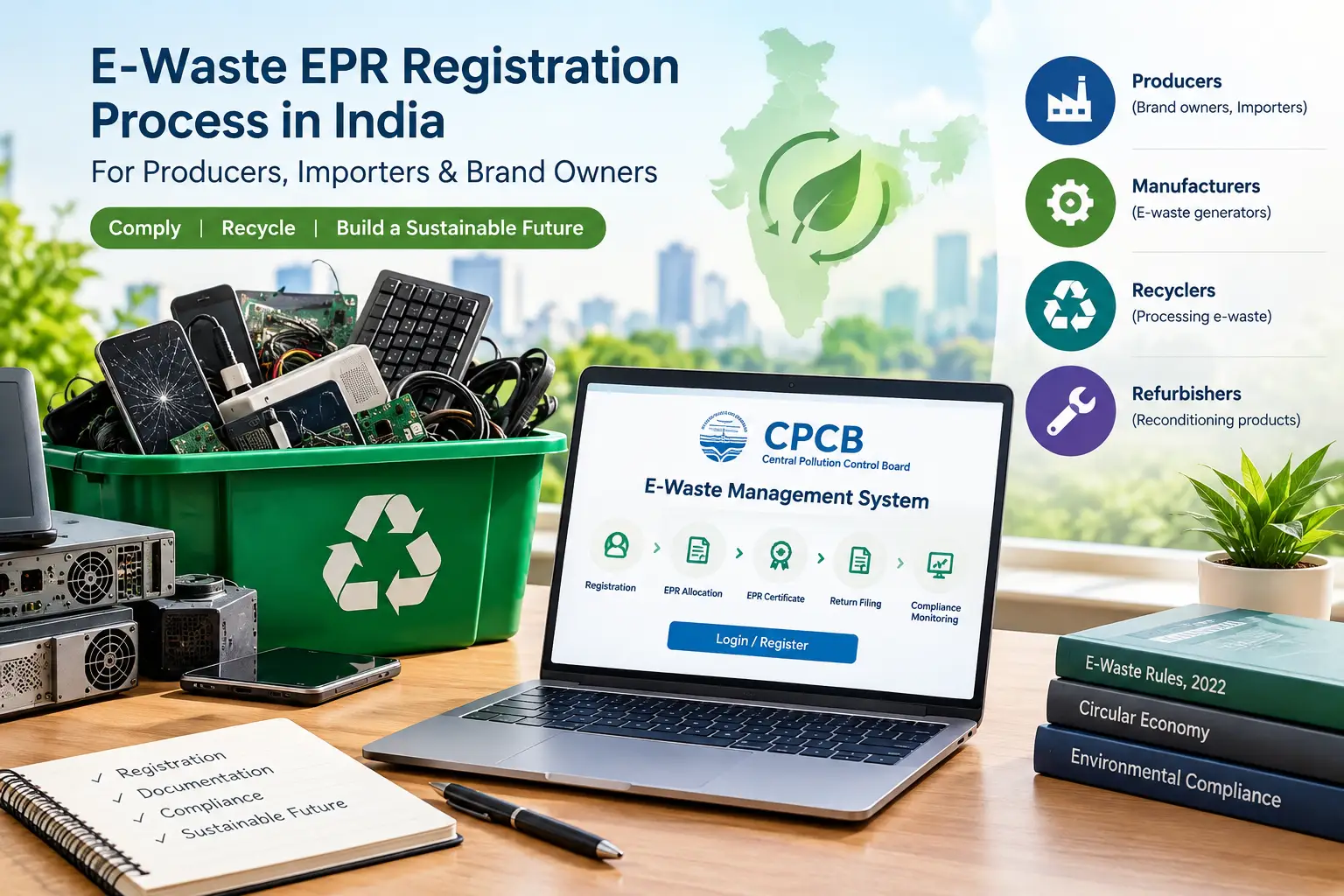
E-Waste EPR Registration Process in India
India is one of the world's fastest-growing generators of electronic waste. With increasing consumption of electrical and electronic equipment (EEE), regulators have introduced a structured Extended Producer Responsibility (EPR) framework to ensure environmentally sound management of e-waste.
The E-Waste (Management) Rules, 2022 introduced a digital compliance framework requiring producers, manufacturers, recyclers, and refurbishers to register on the CPCB E-Waste Portal and fulfill their obligations through an online system. The Rules came into force from 1 April 2023.
This guide explains who requires E-Waste EPR Registration, the registration process, documents required, compliance obligations, and common mistakes businesses should avoid.
What is E-Waste EPR?
Extended Producer Responsibility (EPR) is an environmental policy approach under which producers are responsible for the environmentally sound management of their products after they reach end-of-life.
Under the E-Waste (Management) Rules, 2022, producers are required to ensure that e-waste generated from products placed in the market is recycled through registered recyclers and managed through the CPCB's online E-Waste Management System.
The objective is to:
- Improve e-waste collection and recycling
- Reduce informal disposal practices
- Promote resource recovery
- Strengthen the circular economy
- Improve traceability and accountability
E-Waste EPR forms part of the broader environmental compliance framework applicable to businesses handling electrical and electronic products. Organizations may also need to assess other applicable waste-management obligations depending on their activities.
Legal Framework Governing E-Waste EPR
E-Waste (Management) Rules, 2022
The Rules replaced the earlier E-Waste Management Rules, 2016 and established a centralized digital EPR framework administered by CPCB.
The framework is implemented through the CPCB E-Waste Portal.
Businesses should also evaluate their broader environmental obligations through an Environmental Compliance Checklist for Industries in India where applicable.
Who Needs E-Waste EPR Registration?
The Rules require registration of multiple stakeholders.
Producers
A producer includes an entity that:
- Manufactures and sells electrical and electronic equipment under its own brand
- Sells products under its own brand manufactured by others
- Imports electrical and electronic equipment for sale in India
These entities are responsible for meeting EPR obligations.
Manufacturers
Manufacturers generating e-waste during manufacturing operations are required to register and comply with applicable responsibilities.
Recyclers
Recyclers processing e-waste are required to obtain registration through the CPCB portal and operate in accordance with CPCB guidelines.
Refurbishers
Entities engaged in refurbishment of electrical and electronic equipment are also required to register under the E-Waste Management framework.
What Products Are Covered Under E-Waste EPR?
The Rules apply to a wide range of Electrical and Electronic Equipment (EEE), including:
Information Technology Equipment
- Computers
- Laptops
- Servers
- Printers
- Networking Equipment
Consumer Electronics
- Televisions
- Audio Systems
- Display Units
- Set-Top Boxes
Electrical Equipment
- Electrical Control Equipment
- Power Supplies
- Industrial Electronics
- Monitoring Devices
Communication Devices
- Mobile Phones
- Tablets
- Communication Equipment
The exact list is specified under the schedules of the E-Waste (Management) Rules, 2022.
CPCB E-Waste EPR Portal
The E-Waste Management System is operated through the CPCB online portal. All stakeholders are required to register and conduct compliance activities through this platform. The portal facilitates:
- Registration
- EPR obligation allocation
- EPR certificate management
- Return filing
- Compliance monitoring
CPCB has clarified that producers, recyclers, refurbishers, and manufacturers must register on the portal.
CPCB E-Waste Portal
CPCB E-Waste Management System
E-Waste EPR Registration Process
Step 1 – Determine Applicability
Identify whether the organization falls under:
- Producer
- Manufacturer
- Recycler
- Refurbisher
and whether covered EEE products are being manufactured, sold, branded, or imported.
Correctly identifying the applicable stakeholder category is important because the compliance requirements can differ according to the role of the entity.
Step 2 – Create an Account on CPCB Portal
The applicant creates login credentials on the CPCB E-Waste Portal and selects the appropriate stakeholder category.
Step 3 – Prepare Documentation
The applicant gathers required company, product, and compliance information before submission.
Proper documentation is important because incomplete or inconsistent information can result in queries or delays during scrutiny.
Step 4 – Submit Online Application
The registration application is submitted through the CPCB portal along with supporting documents and declarations.
Step 5 – CPCB Scrutiny
CPCB reviews:
- Entity information
- Product details
- Supporting documents
- Declarations
Additional clarifications may be sought where necessary.
Step 6 – Grant of Registration
Upon satisfactory review, CPCB grants registration on the E-Waste Management Portal. Registration enables the entity to participate in the EPR compliance system.
Registration, however, should not be considered the end of compliance. Registered entities must continue to meet applicable EPR obligations and reporting requirements.
Documents Required for E-Waste EPR Registration
Document requirements may vary depending on stakeholder category; however, commonly required documents include:
Company Documents
- PAN Card
- Certificate of Incorporation
- GST Registration
- CIN Details
- Address Proof
Business Documents
- Import Export Code (IEC) (for importers)
- Authorized Signatory Details
- Board Resolution or Authorization Letter
Product Information
- Product Categories
- Product Descriptions
- Brand Details
- Technical Specifications
Compliance Declarations
- Undertakings
- Self-Declarations
- Application Forms prescribed by CPCB
The exact requirements may vary depending on stakeholder type and portal updates.
Businesses should maintain organized environmental documentation as part of their overall EC Document Checklist in Delhi NCR.
Understanding EPR Obligations
Under the Rules, producers are assigned EPR obligations based on the quantity of electrical and electronic equipment placed in the market.
The EPR framework operates through:
- Registration of stakeholders
- Recycling targets
- EPR certificates generated by registered recyclers
- Online compliance monitoring
The system is designed to ensure traceability of e-waste management activities.
EPR obligations should be tracked along with other applicable waste-management requirements to maintain continuous environmental compliance.
Post-Registration Compliance Requirements
Obtaining registration is only the first step.
Registered entities must:
Maintain Records
Maintain records relating to:
- Products placed in the market
- EPR obligations
- Recycling activities
- EPR certificates
Proper recordkeeping helps demonstrate compliance and supports accurate reporting.
Fulfil EPR Targets
Meet recycling obligations through the CPCB EPR mechanism.
File Returns
Stakeholders are required to file periodic returns through the E-Waste Portal. CPCB regularly issues reminders regarding timely filing of returns and compliance obligations.
Maintain Supporting Documentation
Records should be maintained for:
- Product sales
- Imports
- Recycling certificates
- Compliance submissions
Regular compliance reviews can help identify gaps in records, reporting and documentation before they become regulatory issues.
Common Mistakes During EPR Registration
Businesses frequently encounter delays because of:
- Incorrect stakeholder categorization
- Incomplete product details
- Missing documentation
- Incorrect EEE classification
- Inaccurate declarations
- Failure to respond to CPCB queries
Proper documentation significantly improves approval timelines.
Businesses should also periodically review their overall environmental obligations instead of focusing only on the EPR registration itself.
Penalties for Non-Compliance
Under the E-Waste (Management) Rules, 2022, registration may be revoked if false information is furnished or material information is concealed. Environmental Compensation may also be imposed for violations and non-compliance.
Authorities may also initiate enforcement action for:
- Operating without registration
- Failure to fulfil EPR obligations
- Failure to file returns
- Incorrect reporting
Environmental Compensation can form part of the consequences associated with environmental violations. For broader information, see Environmental Compensation Explained in India: When Industries Can Be Penalized.
Benefits of E-Waste EPR Compliance
Proper compliance helps organizations:
- Meet statutory requirements
- Avoid penalties
- Improve environmental performance
- Demonstrate ESG commitment
- Strengthen sustainability initiatives
- Improve corporate reputation
- Support circular economy objectives
A structured compliance system also helps businesses maintain better records and demonstrate responsible waste-management practices.
Related Guides & Resources
- Plastic Waste EPR Registration Process in India (Complete Guide for PIBOs) →
- Hazardous Waste Authorization Process in India: Complete Compliance Guide →
- Environmental Audit for Industries: Types, Process & Compliance Benefits →
- Form V Environmental Statement Explained: Applicability, Format & Filing Requirements →
- How Long Groundwater NOC Takes →
Need Help with E-Waste EPR Registration?
Simplicomp assists businesses with:
- E-Waste EPR Registration
- CPCB Portal Registration
- EPR Compliance Management
- Annual Return Filing
- EPR Documentation
- Environmental Compliance Support