

Introduction
Sewage Treatment Plant (STP) is an important wastewater management system for residential societies, group housing projects and large residential developments in Noida and Greater Noida. It treats domestic sewage generated from toilets, bathrooms, kitchens and other residential activities before the treated water is reused or discharged as permitted.
Residential developers, builders, housing societies and Resident Welfare Associations (RWAs) should understand the applicable STP requirements during project planning, construction and operation. These requirements may depend on the project size, sewage generation, building approvals, Environmental Clearance (EC) conditions and applicable pollution-control regulations. A structured Environmental Compliance Checklist Industries can help project teams identify relevant approvals and compliance responsibilities.
Simplicomp provides environmental compliance guidance to help residential project owners understand their STP-related requirements in Noida and Greater Noida.
What Is an STP in Residential Projects?
A Sewage Treatment Plant is a facility designed to treat wastewater generated by residents and building occupants. The treatment process reduces organic pollutants, suspended solids and other contaminants to achieve the required treated-water quality. Understanding BOD, COD, TDS and TSS parameters can help project teams understand important wastewater quality indicators.
In residential projects, treated wastewater may be reused for gardening, landscaping and toilet flushing, subject to the applicable standards and project approval conditions.
STPs are commonly relevant to:
- Group housing projects in Noida and Greater Noida.
- Large residential societies and apartment complexes.
- High-rise residential buildings.
- New residential developments.
- Existing housing societies required to comply with applicable environmental or building approval conditions.
STP Requirements for Residential Societies in Noida and Greater Noida
Residential STP requirements should be assessed according to the project's characteristics and the conditions imposed by the relevant authorities.
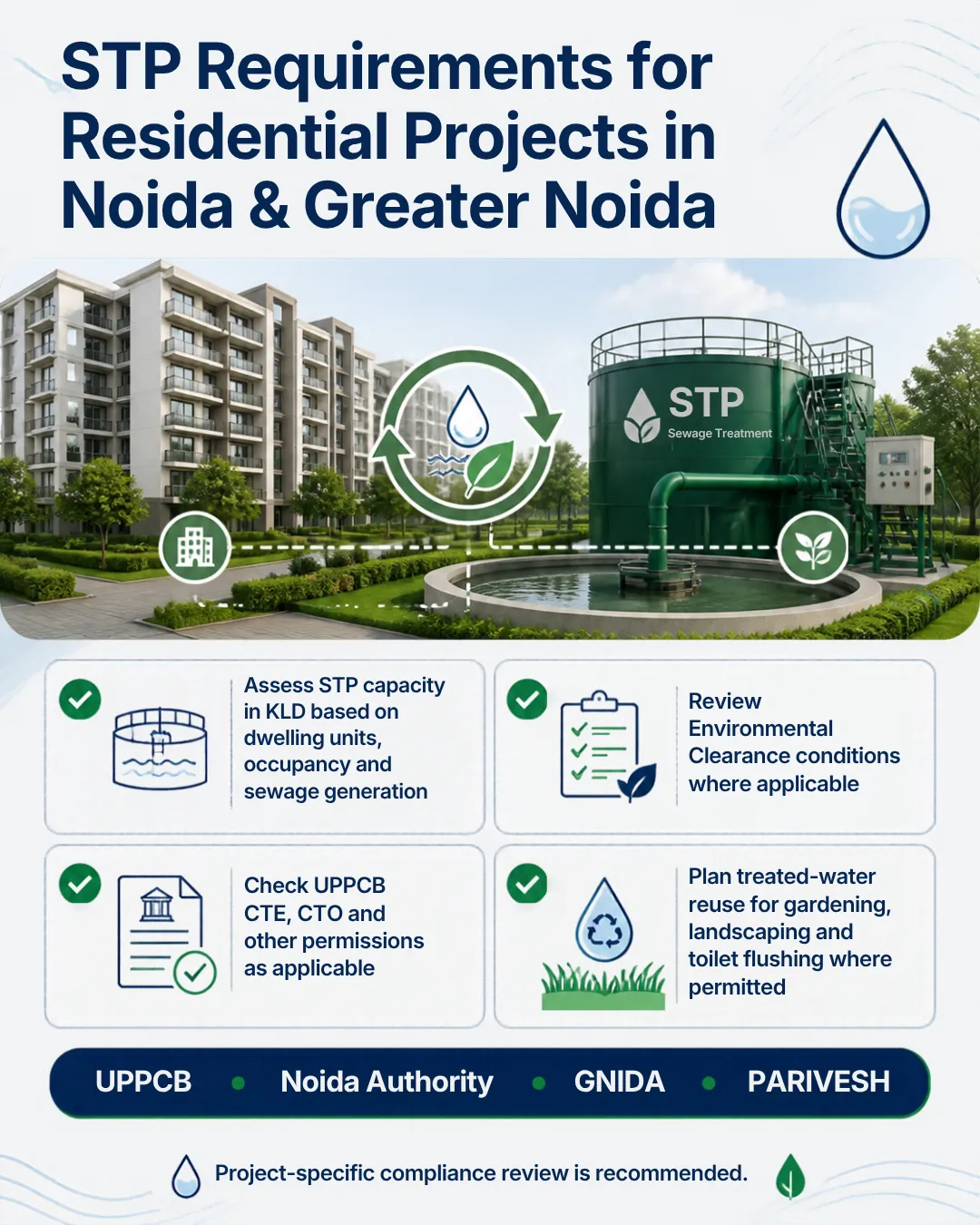
1. STP Capacity Assessment
The STP capacity should be determined by estimating the sewage generated by the residential project. Factors include the number of dwelling units, expected occupancy, water consumption and applicable design criteria.
The capacity is generally expressed in KLD (kilolitres per day). An appropriately designed plant helps ensure that the sewage generated by residents can be treated effectively.
2. Environmental Clearance Requirements
Certain residential and group housing projects may require prior Environmental Clearance under the applicable environmental clearance framework.
Where an EC is required, the project owner should review its conditions relating to sewage treatment, STP capacity, treated-water reuse, wastewater discharge and environmental monitoring. Project teams can refer to the Environmental Approvals and Compliance Checklist for Manufacturing Plants for general environmental approval planning concepts, while confirming the specific requirements applicable to residential projects separately.
3. Pollution Control Board Compliance
Residential projects should determine whether Consent to Establish (CTE), Consent to Operate (CTO) or other pollution-control permissions apply to their particular project.
The applicability of these permissions should be checked against the relevant regulations, project category and approval conditions rather than assumed to be identical for every residential society. For background, see the guides on the Consent to Establish (CTE) process, Consent to Operate (CTO) and the difference between CTE and CTO.
4. Treated Wastewater Reuse
Treated sewage may be reused for appropriate non-potable purposes, such as gardening, landscaping and toilet flushing, where permitted.
Residential developers and society management teams should ensure that the treatment system and reuse arrangements meet the applicable requirements.
5. STP Operation and Maintenance
An STP must be maintained and operated according to its design and applicable compliance conditions. Regular maintenance, equipment inspections, treatment-performance monitoring and appropriate sludge management help maintain operational efficiency.
Where required, residential project operators should maintain treated-water testing reports, maintenance records and other compliance documents. Periodic environmental audits may also help organisations review their environmental performance and identify potential compliance gaps, where applicable.
Which Authorities Should Residential Projects in Noida and Greater Noida Check?
Residential developers and housing societies should identify the authorities responsible for their specific project and approval conditions.
Uttar Pradesh Pollution Control Board (UPPCB): Check applicable pollution-control permissions, wastewater treatment requirements and compliance conditions.
Noida Authority: Residential projects within Noida should review the relevant building, development and project approval conditions.
Greater Noida Industrial Development Authority (GNIDA): Projects within Greater Noida should review the applicable development and building approval requirements.
Environmental Clearance authorities: Where Environmental Clearance is applicable, the project owner should comply with the conditions specified in the relevant EC.
Official websites:
The responsible authority and exact requirements depend on the project's location, category, size and existing approvals.
Documents Required for Residential STP Compliance
The documents required may vary according to the project and its approval conditions. Commonly relevant documents include:
- Approved building plan and project layout.
- Details of dwelling units and expected occupancy.
- Sewage-generation calculations and STP capacity details.
- STP design report and treatment technology specifications.
- Treated-water reuse and discharge arrangements.
- Environmental Clearance and applicable approval documents.
- CTE and CTO documents, where applicable.
- Treated-water quality reports, where required.
- STP operation, maintenance and sludge-management records.
An initial document review can help identify missing information and determine the next compliance steps. A broader Environmental Compliance Checklist may also help teams organise applicable records and approvals.
Common STP Compliance Issues in Residential Societies
Residential societies in Noida and Greater Noida should pay attention to the following issues:
- STP capacity that does not adequately address actual sewage generation.
- Improper operation or inadequate maintenance of treatment equipment.
- Failure to meet applicable treated-water quality requirements.
- Inadequate treated-water reuse arrangements where required by approval conditions.
- Missing water-quality testing or operational records.
- Non-compliance with applicable EC, pollution-control or development authority conditions.
Addressing these issues helps residential project owners and society management teams improve wastewater management and maintain applicable environmental compliance. Depending on the facts and applicable regulations, non-compliance may also lead to regulatory action or environmental compensation.
STP Compliance Support by Simplicomp in Noida and Greater Noida
Simplicomp assists residential developers, builders, housing societies and project management teams in understanding environmental compliance requirements.
Depending on the project scope, support may include:
- Review of applicable residential STP requirements.
- Assessment of Environmental Clearance conditions.
- Guidance on applicable CTE and CTO requirements.
- Review of sewage treatment and wastewater reuse documentation.
- Identification of potential environmental compliance gaps.
- Guidance on relevant pollution-control and development authority requirements.
The services required will depend on whether the project is under construction, newly commissioned or an existing operational residential society.
Conclusion
STP requirements are an important consideration for residential projects in Noida and Greater Noida. Developers and housing societies should assess sewage generation, treatment capacity, treated-water reuse, maintenance requirements and applicable environmental approvals.
A project-specific compliance review helps determine the permissions and operational measures required for the particular residential development. Simplicomp can help project owners understand these requirements and plan their environmental compliance activities.
Related Guides & Resources
- STP Compliance Housing Societies India →
- Builder Site Dust Compliance Checklist Delhi NCR →
- Rainwater Harvesting India →
- CTO Renewal Documents Process →
Need Help with STP, ETP & ZLD Compliance Services
Simplicomp assists industries with:
- Sewage Treatment Plant
- Domestic wastewater treatment
- Industrial wastewater treatment
- Treated effluent disposal/reuse
- Removal of pollutants & chemicals