

Introduction
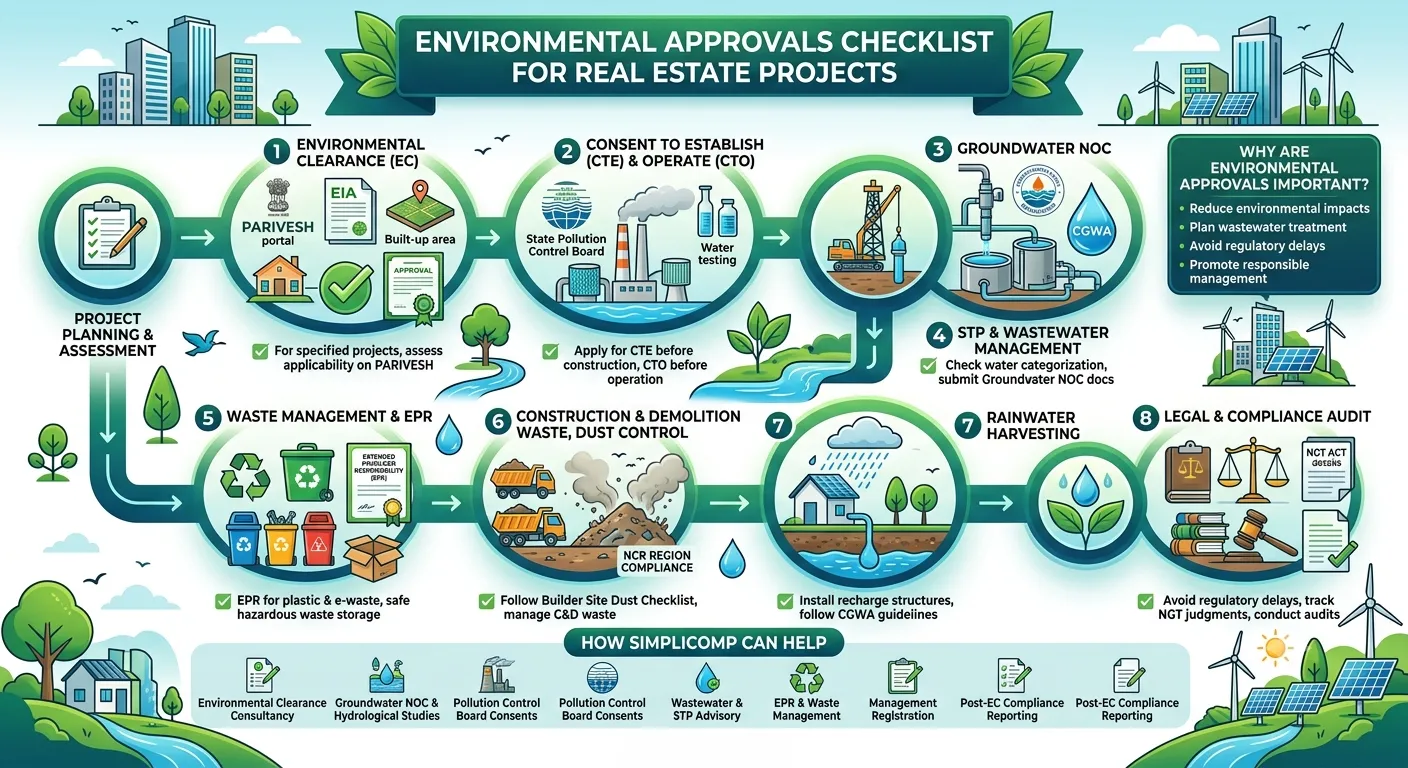
Real estate projects such as residential apartments, commercial complexes, shopping malls, townships and mixed-use developments may require various environmental approvals before construction or operation. These approvals help ensure that projects follow applicable environmental compliance regulations and implement suitable measures for pollution control, water conservation and waste management.
An Environmental Approvals Checklist for Real Estate Projects helps builders, developers and project owners identify the permissions that may apply to their projects. Requirements depend on factors such as project size, built-up area, location, proposed activities and applicable environmental regulations.
Planning approvals at an early stage can help developers organize documentation, coordinate with relevant authorities and reduce the risk of regulatory delays. A project-specific assessment is essential to determine which approvals are applicable before construction begins.
Why Are Environmental Approvals Important for Real Estate Projects?
Real estate development can affect air quality, water resources and the surrounding environment. Construction activities may generate dust, noise and debris, while occupied buildings produce sewage and solid waste. Large developments may also require substantial water and energy resources.
Environmental approvals help developers identify these impacts and establish suitable control measures. They also help project teams plan wastewater treatment facilities, waste management systems, rainwater harvesting and other environmental safeguards.
Obtaining applicable approvals and complying with their conditions can support smoother project execution, better documentation and responsible environmental management.
Key Environmental Approvals for Real Estate Projects
1. Environmental Clearance (EC)
Environmental Clearance for residential projects may be required for specified building, construction, township and area development projects under the applicable EIA Notification and amendments. Applicability depends on the relevant project category, built-up area and other applicable criteria.
Developers should assess EC requirements during project planning and apply for Environmental Clearance on PARIVESH wherever legally required. The process involves submitting the documents required for Environmental Clearance , including details about water demand, sewage generation, solid waste management, energy use and pollution-control measures.
It is important to understand how long Environmental Clearance takes and the cost of Environmental Clearance to plan project timelines and budgets. Developers should also learn how to avoid common mistakes that delay EC approval on PARIVESH and understand the consequences of EC violations. Once clearance is granted, applicable six-monthly EC compliance reports must be submitted as required by the approval conditions and applicable regulations.
2. Consent to Establish (CTE) and Consent to Operate (CTO)
Consent to Establish (CTE) and Consent to Operate (CTO) are permissions issued by the relevant State Pollution Control Board or Pollution Control Committee under applicable pollution-control laws, including the Water (Prevention and Control of Pollution) Act, 1974, and the Air (Prevention and Control of Pollution) Act, 1981, as applicable.
Developers should understand the difference between CTE and CTO and gather the required CTE and Pollution Board NOC documents before establishing a regulated facility. CTE is generally required before establishing a facility, while CTO may be required before commencing regulated operations.
Developers must also follow applicable Pollution Control Board consent conditions and complete the CTO renewal process within the prescribed timeline. Where relevant, project teams should review CPCB industry categorization OCEMS compliance requirements and applicable diesel generator emission-control requirements.
3. Groundwater NOC
Real estate projects proposing groundwater extraction may require a Groundwater NOC or borewell permission from the Central Ground Water Authority (CGWA) or the applicable state groundwater authority, depending on the location, use and prevailing regulatory framework.
Requirements depend on the groundwater categorization of the project location, such as Safe, Semi-Critical, Critical or Over-Exploited. Developers should prepare the appropriate Groundwater NOC documents and follow the applicable borewell permission rules to obtain groundwater extraction permission wherever required.
To help prevent delays, developers should understand how long Groundwater NOC approval takes and assess the need for a hydrogeological study and groundwater impact assessment. Maintaining a comprehensive water balance study and submitting applicable groundwater annual compliance reports and returns are also important for ongoing compliance.
4. Sewage Treatment Plant (STP) and Wastewater Management
Residential and commercial developments generate significant volumes of sewage. Depending on the project, applicable approvals and regulatory conditions, developers may need to install and operate a suitable Sewage Treatment Plant (STP) and maintain the required treatment and monitoring systems.
Developers should review STP compliance requirements for housing societies and commercial complexes. Understanding the difference between STP and ETP helps project teams select suitable treatment systems and capacities. Monitoring parameters such as BOD, COD, TDS and TSS in wastewater is important for evaluating treatment performance and checking compliance with applicable discharge or reuse standards.
For large-scale projects aiming to maximize water recycling, a Zero Liquid Discharge (ZLD) system may be considered where technically and legally appropriate. Treated wastewater may be reused for landscaping, flushing and other suitable non-potable purposes, subject to treatment quality and applicable requirements.
5. Waste Management and Extended Producer Responsibility (EPR)
Real estate projects can generate household waste, packaging waste, e-waste and hazardous waste during construction and operational phases. Developers must identify the waste streams generated by their projects and follow the applicable provisions of the Environment (Protection) Act, 1986 , along with relevant waste-management rules.
Depending on the project activities and the role of the developer, producer, importer or brand owner, certain packaging and electronic products may be subject to Extended Producer Responsibility (EPR) . Applicable obligations may include Plastic Waste EPR registration and E-Waste EPR registration .
Projects that generate or handle regulated hazardous waste must assess whether authorization is required and follow the relevant hazardous waste authorization process . They should also implement safe hazardous waste storage and spill-management practices and complete authorization renewals wherever applicable.
6. Construction and Demolition Waste Management and Dust Control
Construction activities generate concrete, bricks, soil, debris and dust that can affect ambient air quality, particularly in sensitive areas such as the National Capital Region (NCR). Developers should arrange appropriate construction and demolition waste segregation, storage, transportation and disposal in accordance with applicable requirements.
Developers operating in Delhi-NCR should review the Builder Site Dust Compliance Checklist for Delhi NCR and follow applicable dust-control directions issued by the relevant authorities. Failure to comply may result in regulatory action, environmental compensation or other consequences, depending on the circumstances.
Project teams should also understand the relevant environmental compliance requirements and review location-specific restrictions before starting construction.
7. Rainwater Harvesting and Stormwater Management
Rainwater harvesting and stormwater management can help reduce runoff, support groundwater recharge and improve water conservation. Developers should verify applicable rainwater harvesting requirements under CGWA directions, state groundwater authority rules, local building bye-laws and other relevant regulations.
Developers can review the importance and methods of rainwater harvesting in India , including rooftop rainwater harvesting and surface-runoff collection. Suitable groundwater recharge methods should be selected based on site conditions, hydrogeology and local requirements.
Developers should also review rainwater harvesting requirements under CGWA, HWRA and state authorities to understand the provisions applicable to their project.
8. Legal Principles, NGT Jurisdiction and Environmental Audits
Real estate projects must operate within the framework of applicable Indian environmental laws and judicial principles. Important legal concepts include the Public Trust Doctrine , the Precautionary Principle and the Polluter Pays Principle .
Environmental violations may lead to regulatory or judicial action. Developers should understand the role of the National Green Tribunal (NGT) , review the National Green Tribunal Act, 2010 and understand the applicable jurisdiction and powers of the Tribunal. Reviewing major NGT judgments and the rules governing environmental compensation can help project teams understand potential compliance risks.
Regular environmental audits , applicable Form V Environmental Statement filing and environmental due diligence before acquiring property can help identify compliance gaps and potential environmental liabilities. Developers should verify the applicability and filing timelines of each requirement for their specific project.
Environmental Approvals Checklist for Developers
Before starting construction or operations, developers should review the following checklist and confirm the requirements applicable to their project.
Project Planning and Regulatory Assessment
- Confirm the project location, category, built-up area and proposed activities.
- Assess Environmental Clearance applicability under the applicable EIA Notification.
- Identify the competent authorities and verify state-specific environmental requirements.
- Review location-specific environmental restrictions and applicable groundwater laws.
- Identify approval dependencies and prepare a realistic regulatory submission schedule.
Water and Wastewater Management
- Estimate total water demand and prepare a project-specific water balance study.
- Verify proposed water sources and obtain groundwater extraction permissions wherever required.
- Assess STP and ETP requirements and plan treated wastewater reuse.
- Design suitable rooftop and surface rainwater harvesting structures.
- Plan water-quality monitoring and maintain records required under applicable approvals.
Pollution and Waste Management
- Obtain required Consent to Establish before establishing a regulated facility, wherever applicable.
- Set up waste segregation, storage and disposal systems in accordance with applicable rules.
- Assess Plastic Waste EPR and E-Waste EPR obligations based on the project's role and activities.
- Follow applicable dust-control and construction and demolition waste-management requirements.
- Maintain hazardous waste records and obtain required authorizations wherever applicable.
Ongoing Compliance
- Maintain approval letters, NOCs, consent conditions and supporting documents.
- Maintain groundwater extraction, water-use and monitoring records wherever applicable.
- Submit six-monthly EC compliance reports when required by the clearance conditions.
- File annual Form V Environmental Statements where applicable.
- Track approval validity, renewal dates, monitoring obligations and changes in regulatory requirements.
Common Challenges in Environmental Approvals
Developers often face delays when approval requirements are identified late, documentation is incomplete or technical data is inconsistent. Incorrect water-demand calculations, inadequate wastewater planning and poor coordination between consultants can also complicate the approval process.
These challenges can be minimized through early regulatory assessment, accurate documentation and coordination between architects, engineers, environmental consultants and project managers. A centralized compliance tracker can help project teams monitor application status, document requirements, approval conditions and renewal timelines.
If a project layout, capacity or production-related parameter is being modified, developers should assess whether a No Increase in Pollution Load (NIPL) assessment or other regulatory procedure may be relevant. Its applicability depends on the nature of the project, the proposed change and the applicable approval framework; it should not be assumed to replace a required EC amendment or appraisal.
How Simplicomp Can Help
Simplicomp provides environmental consultancy support to real estate developers, builders and project owners to help them understand applicable approval requirements, organize documentation and manage environmental compliance throughout the project lifecycle.
- Environmental Clearance Consultancy: Assessing EC applicability, preparing supporting documentation and guiding projects through the PARIVESH application process.
- Groundwater NOC and Hydrogeological Studies: Supporting CGWA or state groundwater permission applications, hydrogeological studies, groundwater impact assessments and water balance studies.
- Pollution Control Board Consents: Assisting with applicable Consent to Establish (CTE) and Consent to Operate (CTO) applications, documentation and renewals.
- Wastewater and STP Advisory: Supporting STP planning, wastewater treatment assessments, ZLD feasibility and treated wastewater reuse planning.
- EPR and Waste Management Guidance: Helping identify applicable Plastic EPR, E-Waste EPR and hazardous waste compliance requirements.
- Post-EC and Post-Consent Compliance: Supporting applicable compliance reporting, environmental audits, documentation and approval-condition tracking.
Conclusion
An Environmental Approvals Checklist for Real Estate Projects helps developers identify regulatory obligations early, plan environmental infrastructure and organize permissions before construction begins. Key areas include Environmental Clearance, Pollution Control Board consents, groundwater authorization, sewage treatment, waste management, construction dust control and rainwater harvesting.
Since requirements vary according to project size, location, activities and applicable regulations, a project-specific assessment is essential. Early planning and structured compliance management can help reduce avoidable regulatory delays, identify compliance gaps and manage environmental risks.
Contact Simplicomp today to discuss your real estate project and receive expert guidance on environmental approvals, documentation and compliance planning.
Related Guides & Resources
- EIA Clearance Process →
- How to Apply EC Parivesh →
- Factory Setup Environmental Approvals NCR →
- CPCB Industry Categorization Guide →
Need Help with Environmental Compliance?
Simplicomp provides support for:
- Environmental Clearance (EC)
- Forest Clearance / NOC
- Environmental monitoring and reporting
- Wildlife Clearance
- Aravali NOC / Clearance